Silly maybe, maybe not. Millions of things have been envisioned and tested in the last few hundred years of our Electrodynamics revolution.
Yet we most often can only read about the most successful experiments or those that fit well into the current accepted belief systems of science.
So now I pick up musing I had as a child raised and working in my Father's small Radio and then Radio and TV repair shop.
And so my muse turns to the simple and lowly two plate capacitor.
It would seem that if one, say cut two one square centimeter Copper or other metal plates and attached small lead wire to them. One could put between them different insulating materials (Cardboard, Glass Plastic etc) and measure the resulting capacitance of this three element device. And from that get so idea of dielectric spacer's dielectric constant or value. As you would know the Plates area and could measure the thickness of the spacer.
So that seems straight forward and classic.
But now can one see for a given dielectric spacer see a difference in value C or Charge or Discharge Times with differ types of metal plates?
What if the two plates have a different standard electrode potential, say like one of Copper and one of zinc or lead?
Of course a static magnetic field will deflect a moving current in it. Yet how does or does in for XYZ orientations effect our capacitor's characteristics.
What happens if say the dielectric spacer is of two different materials with different dielectric constants ?
What happens if say you create channels or paths using the second dielectric like a printed ink pattern, line dots, spiral etc.?
>>
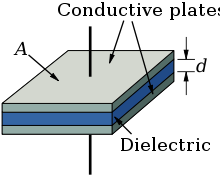
The simplest model capacitor consists of two thin parallel conductive plates separated by a dielectric with permittivity ε . This model may also be used to make qualitative predictions for other device geometries. The plates are considered to extend uniformly over an area A and a charge density ±ρ = ±Q/A exists on their surface. Assuming that the length and width of the plates are much greater than their separation d, the electric field near the centre of the device will be uniform with the magnitude E = ρ/ε. The voltage is defined as the line integral of the electric field between the plates

Solving this for C = Q/V reveals that capacitance increases with area of the plates, and decreases as separation between plates increases.

The capacitance is therefore greatest in devices made from materials with a high permittivity, large plate area, and small distance between plates.
A parallel plate capacitor can only store a finite amount of energy before dielectric breakdownoccurs. The capacitor's dielectric material has a dielectric strength Ud which sets thecapacitor's breakdown voltage at V = Vbd = Udd. The maximum energy that the capacitor can store is therefore

The maximum energy is a function of dielectric volume, permittivity, and dielectric strength. Changing the plate area and the separation between the plates while maintaining the same volume causes no change of the maximum amount of energy that the capacitor can store, so long as the distance between plates remains much smaller than both the length and width of the plates. In addition, these equations assume that the electric field is entirely concentrated in the dielectric between the plates. In reality there are fringing fields outside the dielectric, for example between the sides of the capacitor plates, which will increase the effective capacitance of the capacitor. This is sometimes called parasitic capacitance. For some simple capacitor geometries this additional capacitance term can be calculated analytically.[20] It becomes negligibly small when the ratios of plate width to separation and length to separation are large.
Call / Write or email George.
georgeking@cosmicsalamder.com or pick us up on Facebook
www.facebook.com/teasingTesla
Our Facebook Group:
Our Sister Blogs:
First Principles & Founders of Modern Sciences Introduction
Please help us keep going by clicking on a ad in the blogs each time you read the,
It earns us a few pennies (no need to buy, just give it a quick look).

No comments:
Post a Comment